Home / Criminal Defense
Weatherford · Willow Park · Aledo · Hudson Oaks · Springtown
Criminal Defense in Weatherford, Willow Park, Aledo, Hudson Oaks, Springtown and Throughout Parker County
If you are facing a criminal charge in Parker County, the decisions you make at the beginning of the case can affect what happens next. Andrew Decker Law represents clients facing DWI, weapons charges, aggravated assault, drug offenses, theft, felony charges and other criminal allegations throughout Parker County, including Weatherford, Willow Park, Aledo, Hudson Oaks, Springtown, Annetta and Reno.
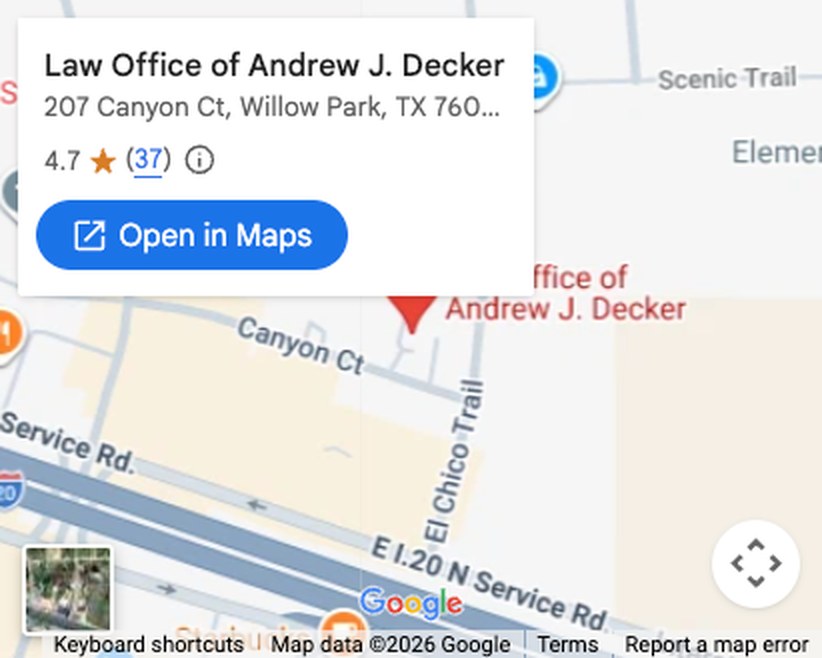
Andrew Decker Law has a Parker County office at 207 Canyon Ct., Willow Park, Texas 76087, with 817-441-1629 as the local office number. The firm also maintains an office in downtown Fort Worth for clients with cases or connections in Tarrant County.
Only your name and phone number are required. We’ll call you back within [X business hours].




A criminal accusation is not a conviction. Before you decide whether to plead guilty, accept an agreement, speak with investigators or take a case to trial, you should understand the charge, the evidence supporting it and the potential consequences. This page explains how criminal cases work in Parker County and what you should consider after an arrest or accusation.
A criminal case in Parker County can begin in many ways. You may have been stopped on the road and arrested for DWI, accused of possessing drugs or a weapon, arrested after an alleged assault, investigated for theft or another property offense, or contacted by police about an allegation involving you. The circumstances are different in every case, but the defense should begin with the same basic questions: What exactly is the State accusing you of doing? What evidence does it have? How was that evidence obtained? And can the State actually prove every element of the offense in court?
Do not assume the police report tells the entire story. A police report is an officer’s account of an investigation, not a complete record of everything that happened. The evidence in a Parker County criminal case may also include body-camera footage, dash-camera recordings, 911 calls, surveillance video, photographs, text messages, phone records, witness statements, search warrants, laboratory results, medical records and other evidence that provides additional context or contradicts what was initially reported. Reviewing that evidence can reveal issues that are not apparent from the arrest report alone.
If you have been arrested or charged in Parker County, what you do next can affect your options. Keep every document you received, preserve messages, photographs, videos and other potentially relevant evidence, and avoid discussing the facts of your case publicly or with people who do not need to know about it. Before making decisions about a DWI, weapons charge, assault, drug offense, felony or other criminal allegation, speak with a criminal defense lawyer who can review the specific charge, evidence, deadlines and potential consequences.
DWI is one of the most serious and common criminal charges facing drivers in Parker County, and an arrest can create both a criminal case and a separate driver’s-license problem. Andrew Decker Law represents people accused of DWI in Weatherford, Willow Park, Aledo, Hudson Oaks, Springtown and throughout Parker County. Texas law refers to the offense as driving while intoxicated, although many people use the term DUI when searching for a DUI lawyer in Weatherford, TX.

A DWI arrest is not the same thing as a DWI conviction. The State still has to prove the elements of the offense beyond a reasonable doubt, and the defense should examine how the traffic stop began, what the officer observed, how the investigation was conducted, what the video shows, and whether any breath or blood evidence was lawfully obtained and reliably tested. A police report is only one part of the evidence. Body-camera footage, dash-camera recordings, witness statements, photographs, 911 calls, medical information, laboratory records and other evidence may provide a different or more complete picture of what happened.
Texas DWI penalties can increase substantially when a person has prior DWI convictions or when aggravating circumstances are alleged. Texas Penal Code Chapter 49 establishes the principal DWI offenses, including ordinary DWI, DWI with a child passenger, intoxication assault and intoxication manslaughter. The classification and punishment depend on the specific charge and circumstances of the case.
A first DWI does not automatically mean the case will result in a conviction. The evidence still needs to be examined. Likewise, a prior DWI does not mean that the State can automatically use every previous arrest or allegation to enhance a new charge. The prior case, conviction, dates and applicable statutes need to be reviewed carefully.
A DWI involving a child passenger can also be treated differently from an ordinary first DWI. Texas Penal Code §49.045 addresses driving while intoxicated with a child passenger younger than 15 and makes the offense a state jail felony. A DWI allegation involving serious bodily injury or death can result in substantially more serious charges under the intoxication-assault and intoxication-manslaughter provisions of Chapter 49.
A DWI defense begins by testing the State’s evidence rather than assuming that an arrest, field sobriety test or reported BAC establishes guilt. The legality of the traffic stop can matter. So can the way field sobriety tests were administered, what the officer’s body camera recorded, whether statements in the police report match the video, and whether a breath or blood test was obtained and handled according to applicable requirements.
A traffic stop must have a lawful basis, and the defense can examine what the officer actually observed before initiating the stop. Field sobriety testing also deserves careful review because balance, coordination, instructions, road conditions, footwear, injuries, medical conditions, fatigue and other circumstances can affect performance. A video recording may show details that are missing from a written report.
Chemical testing creates another area for investigation. A breath-test case may require examination of the testing procedure and relevant records. A blood-test case may require examination of the warrant or consent, the blood-draw procedure, specimen handling, laboratory testing and chain of custody. None of these issues automatically results in dismissal, but a weakness in the State’s evidence can become an important part of the defense.
Hypothetical. An officer reports that a driver showed significant signs of impairment during field sobriety testing. The available video later shows that the testing occurred on an uneven roadside surface and that the officer’s written description leaves out several circumstances surrounding the tests. Those facts would not automatically defeat the DWI charge, but they could give the defense legitimate grounds to challenge the reliability and interpretation of the investigation.
A DWI arrest can create a separate driver’s-license proceeding through the Texas Department of Public Safety’s Administrative License Revocation, or ALR, program. The criminal DWI prosecution and the ALR proceeding are separate matters, which means a person can have an unresolved criminal case while also facing an administrative license suspension.
In many DWI cases, the deadline to request an ALR hearing is 15 days from the date the person receives the applicable notice. Missing the applicable deadline can result in the suspension proceeding without the requested hearing. Texas Transportation Code Chapters 524 and 724 govern important portions of the administrative suspension process.
Depending on the circumstances, a driver may also need to address an ignition-interlock requirement or determine whether an occupational driver’s license is available. These issues can affect someone’s ability to work, take children to school, attend appointments and handle ordinary responsibilities, so they should not be treated as an afterthought to the criminal case.
Andrew Decker Law handles DWI defense in Parker County and understands the importance of examining both the evidence and the local court process. The firm’s DWI work includes challenging the State’s evidence when the facts and law provide a basis to do so, rather than treating the arrest report as the final word on what happened.
Andrew Decker Law has handled DWI cases in which the charges were dismissed or dropped after the defense identified issues in the prosecution’s case. If you are seeking a DWI lawyer, you would be wise to include Andrew Decker Law in your considerations.
For someone arrested in Weatherford, Willow Park, Aledo, Hudson Oaks, Springtown or elsewhere in Parker County, local familiarity can matter because the case must be evaluated in the context of the particular court, investigating agency, evidence and procedural deadlines involved. Andrew Decker Law’s Parker County office is located at 207 Canyon Ct., Willow Park, Texas 76087, and the local office phone number is 817-441-1629.
If you have been arrested for DWI, preserve the paperwork and evidence you received and pay attention to any driver’s-license deadlines. A DWI charge is an allegation, not a conviction, and the evidence should be examined before you make decisions that could affect your license, employment, finances or criminal record.
Gun and weapons charges can involve much more than simply possessing a firearm. Depending on the circumstances, a person may be accused of unlawful carrying, prohibited possession, possessing a weapon in a restricted location, or using or exhibiting a firearm in connection with another offense. Texas weapons offenses are primarily addressed in Chapter 46 of the Texas Penal Code, and the classification of an offense can depend on the type of weapon, where it was found, the person’s history and what prosecutors allege occurred.

A weapons case should begin with a careful examination of how police discovered the firearm or other weapon. If it was found during a traffic stop, search of a vehicle, search of a home or investigation of another offense, the legality of that search can become an important issue. The defense should also examine whether the State can prove that the accused actually possessed the weapon. Finding a gun in a shared vehicle or residence does not automatically establish who knew about it or exercised control over it.
Prior convictions can create additional firearm restrictions under Texas law. A person facing a prohibited-possession allegation should have the actual prior conviction reviewed rather than assuming that any criminal history creates a firearm prohibition. The dates, offense involved, judgment and circumstances of the current allegation can all matter.
Andrew Decker Law represents clients facing gun and weapons charges throughout Parker County, including Weatherford, Willow Park, Aledo, Hudson Oaks and Springtown. The defense may involve challenging a search, examining possession evidence, reviewing body-camera and other recordings, or determining whether the State can prove each element of the particular weapons offense.
Drug charges in Parker County can range from possession of a controlled substance to allegations involving drug delivery, manufacturing or possession with intent to deliver. The potential consequences depend on the substance involved, the amount alleged, the applicable penalty group, the location of the alleged offense and the person’s prior criminal history. Texas controlled-substance offenses are primarily governed by Chapter 481 of the Texas Health and Safety Code.

A drug possession case is not simply about what police say they found. The defense should examine where the substance was located, who had access to the location, whether the accused knew it was there, how police obtained the evidence, and whether the State can establish that the substance was actually a controlled substance. Laboratory testing, photographs, statements, search warrants, consent and the chain of custody can all become relevant.
Search-and-seizure issues can be particularly important in drug cases. A substance discovered during a vehicle search, home search, traffic stop or warrant execution may raise questions about whether police had the required legal authority to conduct the search and seize the evidence. If the search was unlawful, the defense may have grounds to challenge evidence obtained as a result.
Drug allegations can also carry consequences beyond the potential sentence. A conviction can affect employment, professional opportunities, education, housing and future criminal cases. Andrew Decker Law evaluates drug charges based on the actual evidence and the statute alleged rather than treating the accusation itself as proof of guilt.
An assault allegation can move quickly from a personal dispute into a criminal case. Parker County assault cases can involve allegations between strangers, acquaintances, spouses, dating partners, family members or people who live together. Texas law also provides enhanced consequences for certain assault allegations involving family or household members and for allegations involving prior family-violence convictions.

The circumstances surrounding an alleged assault matter. The defense may need to examine photographs, medical records, 911 recordings, text messages, social-media messages, witness accounts, surveillance footage, body-camera recordings and statements made by the people involved. In some cases, the evidence may show a substantially different version of events from the initial allegation.
A common misconception is that a criminal assault case automatically disappears because the alleged victim no longer wants to prosecute. The decision to continue or dismiss a criminal charge belongs to the prosecutor, not simply the person who made the original complaint. The defense therefore needs to evaluate the evidence and legal issues independently of whether the alleged victim wants to participate.
Family-violence allegations can also have consequences outside the immediate criminal charge. Protective orders, restrictions on contact, firearm restrictions, employment issues, child-custody disputes and future enhancement consequences may become relevant depending on the circumstances. Andrew Decker Law represents people accused of assault and family violence throughout Parker County and evaluates the criminal charge together with the evidence and related legal issues.
Aggravated assault is a serious Texas criminal offense that can carry felony consequences depending on the circumstances alleged. Texas Penal Code §22.02 generally addresses aggravated assault when an assault involves circumstances such as serious bodily injury or the use or exhibition of a deadly weapon.

The exact allegation matters. A case involving an alleged firearm, knife, serious injury, family member or other circumstance can raise different legal and factual questions. The defense should examine what actually happened, what injuries are documented, what witnesses reported, whether video exists, what statements were made, and whether the evidence supports the specific elements prosecutors must prove.
Other serious violent-crime allegations can involve deadly conduct, robbery, kidnapping, sexual offenses or offenses involving weapons. The potential consequences of a felony conviction can extend well beyond the sentence imposed by a court, which makes early investigation of the evidence particularly important.
Andrew Decker Law represents clients facing serious criminal allegations in Parker County and can evaluate whether the evidence supports the charge filed by the State, whether important evidence should be challenged, and what legal options may be available based on the specific facts.
Property crimes in Parker County include allegations involving theft, burglary, robbery, criminal mischief, fraud and other offenses involving property or money. These charges are not interchangeable. The classification and potential punishment can depend on the value of property involved, the type of property, the location entered, whether force or threats were alleged, and other circumstances defined by Texas law.
Burglary and robbery in particular can carry substantially greater consequences than ordinary theft. A burglary allegation may involve questions about whether the person entered a building or habitation without the required consent and with the mental state required by the statute. A robbery allegation can involve additional questions about force, threats or bodily injury.
The defense should examine the evidence connecting the accused to the alleged offense. Surveillance footage, fingerprints, photographs, electronic records, financial records, witness statements, text messages and other evidence can either support or contradict the allegations. The State still has the burden of proving the charged offense beyond a reasonable doubt.
A felony charge can affect your freedom, finances, employment, family and future long after the initial court date. Felony cases in Parker County can involve DWI, aggravated assault, serious drug offenses, weapons charges, burglary, robbery and other offenses established by Texas law.

Felony cases require careful attention to the exact charge, potential punishment range, prior convictions, evidence, court proceedings and available defenses. The difference between a misdemeanor and felony classification can be substantial, and certain convictions can create additional consequences involving firearm possession, professional licensing, immigration, voting rights or future criminal enhancement.
Andrew Decker Law represents clients facing felony and misdemeanor criminal charges in Parker County, including Weatherford, Willow Park, Aledo, Hudson Oaks and Springtown. The firm’s approach is to examine the evidence and the applicable law before making decisions about how a case should be resolved. Depending on the circumstances, that may mean challenging evidence, negotiating a resolution, pursuing dismissal or preparing the case for trial.
A misdemeanor charge is less serious than a felony classification, but it can still result in jail exposure, fines, probation, driver’s-license consequences, a criminal record and other restrictions depending on the offense. Common misdemeanor allegations can include certain DWI offenses, assault, theft, drug possession, weapons offenses and other charges.

The fact that a charge is classified as a misdemeanor does not mean the evidence should be ignored. A misdemeanor conviction can affect employment, professional opportunities, insurance, education and future criminal cases. The defense should still examine how the investigation began, what evidence exists, and whether the State can prove the charge.
Andrew Decker Law handles misdemeanor defense throughout Parker County and evaluates each case according to the particular facts, evidence and law involved.
A criminal defense case should begin with the evidence, not simply with the accusation. The State must prove the charged offense beyond a reasonable doubt, so the defense should examine how the investigation began, what police did, what witnesses reported, what physical or digital evidence exists, and whether the prosecution can actually prove every required element of the offense.
The Fourth Amendment protects against unreasonable searches and seizures, and Texas law provides additional protections that may apply depending on the circumstances. A search of a vehicle, residence, phone or other property may require consent, a warrant, probable cause or another legally recognized basis. If evidence was obtained unlawfully, the defense may have grounds to challenge its use in court.
Search warrants also deserve careful review. The affidavit presented to a judge or magistrate is supposed to establish the legal and factual basis for the requested search. If important information was misstated or the affidavit failed to establish the required legal basis, the defense may have grounds to challenge evidence obtained through the warrant.
Witness testimony should be examined just as carefully. A witness may have made different statements at different times, may have a personal interest in the outcome, or may remember an event differently from another witness. Those circumstances do not automatically make someone unreliable, but they can become important when the prosecution’s case depends heavily on a particular person’s account.
Video evidence can provide another perspective. Body-camera footage, dash-camera recordings, business surveillance, doorbell cameras and cellphone videos may show circumstances that are missing from a police report or witness statement. The complete recording can sometimes provide important context about what actually happened.
Digital evidence also requires context. A screenshot of a text message may not show the conversation before or after it. A social-media post may not establish the circumstances in which it was created. A phone-location record may show where a device was located without proving who was using it. The underlying evidence should be examined before conclusions are drawn.
Andrew Decker Law approaches Parker County criminal cases by examining the evidence and the law rather than simply accepting the allegations in a police report. The goal is to identify the issues that actually matter and determine what options may be available under the circumstances.
Parker County criminal cases proceed through the Texas court system, with the appropriate court depending on the type and classification of the offense. Weatherford is the county seat of Parker County and the location of the county’s principal governmental and court operations.
A misdemeanor and a felony do not necessarily follow the same process or appear before the same court. The court’s jurisdiction depends on the charge and applicable law, and a criminal case may involve multiple court settings before reaching a final resolution.
The first court appearance is not necessarily where the most important decisions are made. The defense may still need to obtain discovery, review body-camera footage, investigate witnesses, examine search warrants, evaluate laboratory results, or identify legal issues that could affect the prosecution’s evidence.
A criminal case can take time because the defense needs an opportunity to investigate what actually happened. A quick plea agreement is not automatically a good result, just as going to trial is not automatically the right decision. The appropriate course depends on the evidence, the charge, the client’s objectives and the legal options available.
Andrew Decker Law works with clients through the different stages of a criminal case and explains what each court setting means, what decisions need to be made, and what issues should be addressed before the case moves forward.
Some criminal cases are dismissed, but dismissal should never be guaranteed before the evidence has been reviewed. A dismissal may become possible when the State cannot prove an essential element, important evidence is successfully challenged, witnesses or evidence become unavailable, or the prosecution determines that continuing the case is not appropriate.
Andrew Decker has represented clients in criminal cases that have resulted in dismissals, not-guilty verdicts at trial and pleas to lesser charges. Those results reflect prior cases and do not guarantee a particular outcome in another case. Every prosecution depends on its own facts, evidence, procedural history and applicable law.
The defense should therefore avoid making decisions based solely on the label attached to the charge. The more important questions are what the State can prove, what evidence can be challenged, what legal defenses may apply, and what resolution best protects the client’s interests.
Probation and deferred adjudication may be available in some Texas criminal cases, but neither is available automatically. Eligibility can depend on the offense, prior criminal history, statutory restrictions, the facts of the case and the terms of a proposed resolution.
Deferred adjudication generally involves a plea followed by an order that defers a final adjudication of guilt while the defendant completes conditions imposed by the court. Successfully completing those conditions can result in a legal outcome different from a conventional conviction, but deferred adjudication does not have the same effect for every offense or every future legal issue.
A person should not accept deferred adjudication simply because it sounds better than a conviction. The defense should consider supervision requirements, driver’s-license consequences, employment, professional licensing, immigration consequences, firearm restrictions, future enhancement rules, and whether the particular disposition may qualify for an expunction or nondisclosure later.
The same principle applies to probation. A proposed probation agreement should be evaluated based on its actual conditions and long-term consequences rather than simply the fact that it avoids immediate incarceration.
Parker County includes Weatherford, Willow Park, Aledo, Hudson Oaks, Springtown, Annetta, Reno and other communities. Criminal investigations can involve different law-enforcement agencies depending on where an alleged offense occurred.
A case may involve the Parker County Sheriff’s Office, Texas Department of Public Safety, Weatherford Police Department, Willow Park Police Department, Hudson Oaks Police Department, Aledo Police Department, Springtown Police Department or another agency depending on the location and circumstances.
The location of an arrest can help identify the agency involved, the records that need to be requested, and the court in which the case may be filed. It can also help determine where body-camera footage, dispatch records, surveillance recordings, search warrants, photographs and other evidence may be maintained.
Weatherford is the county seat and an important center for Parker County criminal proceedings. Willow Park is home to Andrew Decker Law’s Parker County office at 207 Canyon Ct., Willow Park, Texas 76087, with a local office number of 817-441-1629.
Weatherford is the county seat of Parker County and a central location for criminal cases arising throughout the county. Someone searching for a criminal defense lawyer in Weatherford may be dealing with a DWI, drug charge, weapons allegation, assault, theft, felony or another criminal offense.
The important question is not simply where someone was arrested. The defense needs to identify the exact charge, the arresting agency, the court handling the case, the available evidence and the potential consequences before determining how the case should be approached.
Andrew Decker Law’s Parker County office in Willow Park serves clients facing criminal charges connected to Weatherford and communities throughout Parker County.
Willow Park and Aledo are communities in eastern Parker County with close connections to the Fort Worth metropolitan area. People living in these communities may work in Fort Worth while facing a criminal case in Parker County, making the distinction between where someone lives and where an alleged offense occurred particularly important.
Andrew Decker Law’s Parker County office is located in Willow Park, providing a local office for clients dealing with criminal charges in the surrounding communities.
Hudson Oaks is located along the Interstate 20 corridor, while Springtown is farther north in Parker County. Criminal investigations in these communities can involve different agencies and circumstances, so the defense should determine exactly where the alleged conduct occurred and which agency conducted the investigation.
That information can matter when obtaining evidence. Police reports, body-camera recordings, dispatch records, surveillance video, search warrants and other materials may be maintained by different agencies and records custodians.
Parker County’s location immediately west of Fort Worth means that many people have connections to both counties. Someone may live in Weatherford or Willow Park and work in Fort Worth, or live in Fort Worth while facing a criminal case arising from an alleged offense in Parker County.
The location of the alleged offense remains important. A Parker County criminal case does not become a Tarrant County case simply because the defendant lives or works in Fort Worth. Likewise, a Fort Worth offense does not become a Parker County case because the defendant lives in Willow Park.
Andrew Decker Law maintains offices in both locations, with the Parker County office at 207 Canyon Ct., Willow Park, Texas 76087, and the Fort Worth office at City Center, 301 Commerce Street, Suite 2001, Fort Worth, Texas 76102.
Free, confidential consultation at our downtown Fort Worth office.
817-332-3822Fort Worth Office
301 Commerce Street, Suite 2001
Fort Worth, TX 76102
FAQ
You should consider speaking with a criminal defense lawyer as soon as possible after an arrest or criminal accusation. Early legal advice can help you understand the charge, release conditions, deadlines, evidence issues and potential consequences before you make decisions that could affect the case.
You generally have the right to remain silent and speak with an attorney before answering substantive questions about a criminal investigation. You should never lie to police or destroy evidence, but you also should not assume that giving a detailed explanation will make an investigation disappear. Statements can become evidence in the prosecution’s case.
The alleged victim generally does not personally control whether a criminal case is prosecuted. The prosecutor represents the State and makes decisions about continuing or dismissing the criminal charge. The alleged victim’s wishes may be relevant, but they do not automatically require the prosecutor to dismiss the case.
A DWI can potentially be dismissed, but the possibility depends on the facts and evidence in the particular case. The defense may examine the traffic stop, field sobriety testing, breath or blood testing, warrants, video evidence and other issues. No responsible lawyer should guarantee dismissal before reviewing the actual case.
A weapons charge should be evaluated based on the exact weapon, conduct, location and statute involved. Texas has multiple weapons offenses with different requirements. The defense should also examine how police discovered the weapon and whether the search or seizure was lawful.
Aggravated assault is generally a felony, although the exact classification depends on the circumstances and applicable statute. Texas Penal Code §22.02 addresses aggravated assault involving circumstances such as serious bodily injury or the use or exhibition of a deadly weapon.
There is no single fee for criminal defense representation. The cost can depend on the charge, whether it is a misdemeanor or felony, the amount of evidence, investigation required, expected court appearances, motions, negotiations, and whether the case proceeds to trial. Andrew Decker Law can explain its fee structure based on the specific case.
Some criminal cases can be resolved in a way that avoids a felony conviction, but there is no automatic right to a reduction. Whether a reduction or another disposition is possible depends on the offense, facts, criminal history, prosecutor, court and applicable law.
A criminal charge can affect employment, particularly when the accusation involves a professional license, security-sensitive position, commercial driving, healthcare, education, finance or another regulated occupation. The effect depends on the employer, licensing authority, charge and final disposition.
No. An arrest and a conviction are different things. An arrest can create a record even when the case does not result in a conviction, while a conviction is a formal finding of guilt. Texas law provides procedures for qualifying records, including expunction and orders of nondisclosure, but eligibility depends on the disposition and applicable statutory requirements.
Contact your lawyer immediately if you missed a required court appearance. Depending on the circumstances, the court may have issued a warrant or taken another action. The defense needs to determine what happened and address it promptly rather than allowing the missed appearance to remain unresolved.
You can still need a Parker County criminal defense lawyer even if you live somewhere else. The location of the alleged offense generally determines where the criminal case is handled, not simply where you live. Someone who lives in Fort Worth, Dallas, another Texas county or outside the area may still have a criminal case arising in Parker County.
Free Consultation
Don’t wait to protect your rights. Get confidential, experienced representation from a North Texas criminal defense attorney. Contact us today to discuss your case.
Call or text
Call NowFree, confidential consultation
Serving Parker, Tarrant & surrounding counties
[Office hours / after-hours availability]
Only your name and phone number are required. We’ll call you back within [X business hours].